• 2 Posts
  • 23 Comments
Joined 3 years ago
cake
Cake day: June 11th, 2023

help-circle
  • I’m not a representative sample, but…

    …my hobby is my job. I learnt to code and to build stuff as a hobby, and now it’s my job.

    I don’t think I could exist without designing and building something interesting. Even if I know that someone out there does it better. Because I want to understand the process and be able to alter it. I’m OK with someone else doing something that I find boring. If the subject interests me, I want to do it myself.

    As for the concept of being free, if someone said “you’re free now”, I would ask “in what sense - am I free to stop paying taxes and repaying debt? can I finally squat land, start a license free mobile phone network and start practising medicine, or free in some other sense?”. I would likely conclude that I’m not free yet, and mutual dependencies are in fact quite numerous.


  • Out of curiosity I checked if their sources properly accounted for confounding variables (e.g. age, because the global population is aging). I didn’t check all, but all the sources that did I check accounted for age properly.

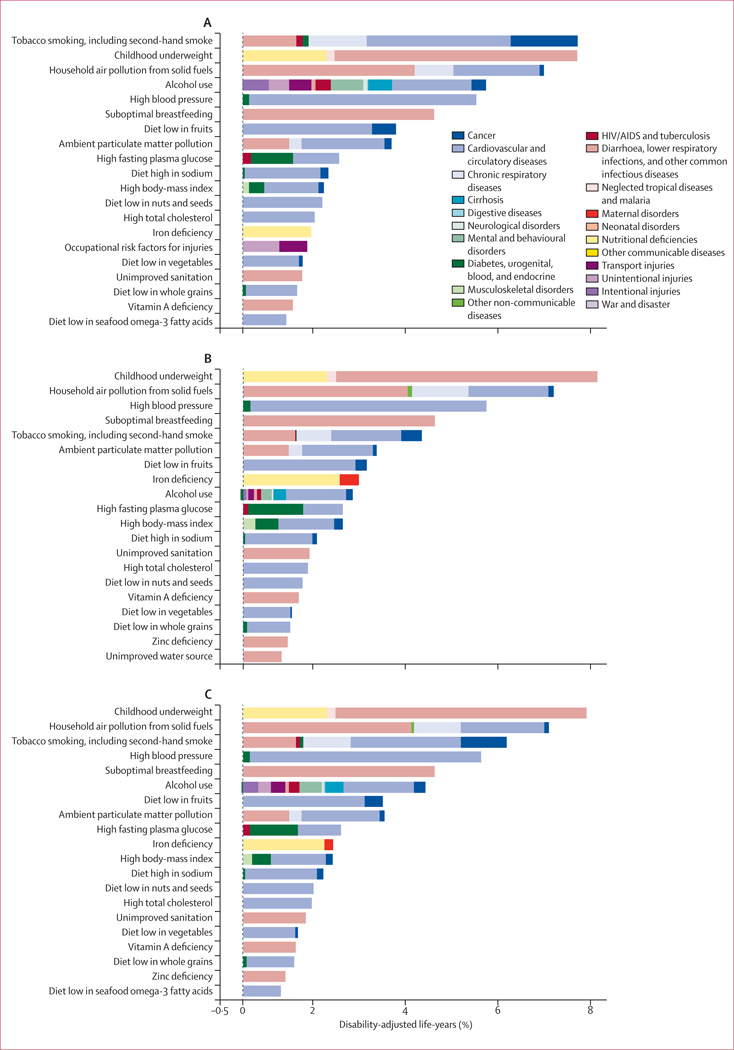
    Then I scanned some more. To bring a medical viewpoint into the discussion, took a particularly close look at one of the referenced studies of 67 health risk factors, to determine if it’s stress, pollutants, communicable or environment-triggred disease that is harming people most.

    The factors dishing out most harm seem to be diseases with a lifestyle / stress component (high blood pressure), behaviour patterns with a stress component (overconsumption of food and intoxicants, primarily alcocol and tobacco), and only after these comes home air pollution (cooking with open fire in developing countries). Outdoor air pollution (“ambient particulate matter pollution”) isn’t in the top 5, but one one diagram, it’s factor number six.

    (Reservation of judgement: there’s not enough data yet about chemicals in the food chain. Pesticides and microplastics definitely need attention, there is absolutely no reason to expect no effect. The effect has to be measured and summarized.)

    Quoting the relevant passage from “A comparative risk assessment of burden of disease and injury attributable to 67 risk factors and risk factor clusters in 21 regions, 1990-2010: a systematic analysis for the Global Burden of Disease Study 2010”

    Findings: In 2010, the three leading risk factors for global disease burden were high blood pressure (7·0% [95% uncertainty interval 6·2-7·7] of global DALYs), tobacco smoking including second-hand smoke (6·3% [5·5-7·0]), and alcohol use (5·5% [5·0-5·9]). In 1990, the leading risks were childhood underweight (7·9% [6·8-9·4]), household air pollution from solid fuels (HAP; 7·0% [5·6-8·3]), and tobacco smoking including second-hand smoke (6·1% [5·4-6·8]). Dietary risk factors and physical inactivity collectively accounted for 10·0% (95% UI 9·2-10·8) of global DALYs in 2010, with the most prominent dietary risks being diets low in fruits and those high in sodium. Several risks that primarily affect childhood communicable diseases, including unimproved water and sanitation and childhood micronutrient deficiencies, fell in rank between 1990 and 2010, with unimproved water and sanitation accounting for 0·9% (0·4-1·6) of global DALYs in 2010. However, in most of sub-Saharan Africa childhood underweight, HAP, and non-exclusive and discontinued breastfeeding were the leading risks in 2010, while HAP was the leading risk in south Asia. The leading risk factor in Eastern Europe, most of Latin America, and southern sub-Saharan Africa in 2010 was alcohol use; in most of Asia, North Africa and Middle East, and central Europe it was high blood pressure. Despite declines, tobacco smoking including second-hand smoke remained the leading risk in high-income north America and western Europe. High body-mass index has increased globally and it is the leading risk in Australasia and southern Latin America, and also ranks high in other high-income regions, North Africa and Middle East, and Oceania.

    My personal conclusion: it’s not pollutants harming us yet. Pollutant densities may well increase (but many are decreasing, e.g. people are cooking less with gas and solid fuel) but our social conditions are stressful as shit, and that encourages certain behaviours which have an evolutionary factor.

    E.g. people are prone to over-eat when they have plentiful food, even if the food is junk and there’s no need to eat more. A sedentary lifestyle and driving instead of walking then doubles down on that. People are prone to relieve stress by consuming tobacco and alcohol, despite it harming them. Our ancestors didn’t have an unlimited access to food, booze and stuff to smoke for a passtime, and didn’t evolve defense mechanisms against such behaviour patterns.

    But as usual, culture getst to be the first responder. Genes will take millenia to get anything done, but culture can get things done in decades. Awareness of how people harm their health, and awareness of how society may be encouraging self-harm, needs to spread.




  • All good points. And I haven’t played with a multitude of sensors. The only cooled sensor I will have anytime soon is my uncooled sensor + liquid gas evaporating.

    Something I’ve wondered about is maybe using these MIR LED’s that have come out to see if you can get the wratten filter to pop, then use a laser system to saturate the detector. Its not clear to me that you can effectively camouflage when its a multiband sensing system. But maybe you can find the detectors and blast them with enough light they can’t see shit.

    Coincidentally, as another experiment, I tried a fast flavour of thermite to get solar protection triggered on my camera (if solar protection is triggered, this particular product goes into shutdown). Sadly, I could not trigger it. With more than a matchbox full of thermite, maybe I would, but at an impractically close distance. I did however achieve my solar charging controller turning on, and starting to charge batteries off the light produced from thermite. Not for very long, about 5 seconds. :)

    Lasers of an appropriate wavelength, generally speaking, should work. A laser within the transmittance curve of germanium would get into a thermal camera with fairly good certainty. But lasers cost so much that an interceptor drone with a net gun is likely cheaper. :)

    In a military context, if one wants soft defense, one might point a microwave beam at the drone to mess with its onboard electronics, but this also requires ridiculous amounts of power (at least several kilowatts) and has limited range, and in a civilian context, there may not be adequate warning of a drone being present, unless one also carries a thermal camera (then it shines like star).


  • the able bodied revolutionary

    This passage suggests an assumption - that anarchist society is reached through a revolution that requires forceful action. Or maybe war. But, I must note - even in disputes that were settled with artillery, not all revolutionaries were able bodied.

    However, if the previous assumption is true, the subsequent conclusion is indeed true. In a war, you can’t depend on reliable supplies of medicine, fuel, electricity or even food and drinking water. A factory or warehouse may get bombed. A power plant may get bombed. A water treatment plant may get bombed.

    Then again, I must remaind: states are quite and very capable of waging war, without any anarchist assistance. Yet people dare to live in states, despite risk that a local state will go crazy and attack others, or the risk that a foreign state will invade.

    “We don’t exactly have alternatives, Sherlock”, one would surely counter. And indeed, most of Earth is owned by some state or another, except Antarctica. Lucky people can pick the flavour and intensity of statism they live under. Less fortunate ones dont’ get a meaningful choice.

    And indeed, a lot of people on Earth right know… would not have the option of getting insulin - despite living under a full blown hierarchy - not to mention accessing a tailor-made cancer vaccine (most of us on Lemmy don’t have that option either).

    What would anarchism change?

    Well, for a start, it might be permissible to cook it up at home. Speaking as an ex-biologist: you need a bioreactor and purification process or animal organs and a purification process to get insulin. Once you start making it, there’s no point making it for one patient only. There’s no point in making antibiotics for one patient only. There’s no point in making vaccines for one patient only.

    So you industrialize and standardize the process. And I don’t see anything in anarchist ideology saying “no, you shall not industrialize any process or announce a standard”. I see critique of how resources are managed. Anarchism criticizes hierarchies of power (wealth == power). It does not typically critique medical or technical advancement, unless some form of advancement alienates people from their rights or concentrates power. Anarchism does criticize large organizations, but only a few tendencies of anarchism conclude that large organizations may not exist. Sometimes they’re needed. Risks that they bring can be grounded in various ways.

    …but getting back to the beginning, I think one should try to reach anarchy without war. War very much necessitates acting like a state to maximize chances of victory. It shouldn’t be the first option for an anarchist, and might actually be a the last option to try (when a choice has been forced and nothing peaceful has worked).

    From a personal perspective…

    In that kind of scenario, I just…die.

    Emigrating from a place where violent conflict looks to be imminent, would be advisable if once needs advanced medical care.


  • My take: a reasonably universal method of payment beats barter, because in a barter economy you can get stuck trying to exchange beans for oars, while the oar maker wants wood or carrots, and the wood cutter needs pumpkins or saw blades instead of peas. :)

    However, a universal method of payment will create a finacial sector, and to avoid adverse outcomes, activity in the financial sector needs to match certain criteria. Typically there’s a state regulating things. In an anarchist economy, regulation would decentralized, but there would have to be regulation.

    E.g. if there’s a currency, there has to be a mechanism protecting against issuing forged currency. It doesn’t have to be goons with guns (recent takes have involved cryptography instead of them), but a mechanism has to exist.


  • As much as I would like to agree, states have historically been far better at fighting wars than most kinds of anarchist organization. Yes, there have been bumbling fools here and there, states can be miserable at innovation - but their organizational model usually prevails if given some time. :(

    The methods of state warfare and non-state insurgency differ a lot. A war is financed by the tax office, an insurgency is mostly financed by donation, theft and loot. A tax office will get a great deal further in raising money than even the most talented partisan, because they are pretty uncontestable and systematically squeeze everyone.

    State-like methods will have industries leveraging scaling laws and division of labour to produce faster and cheaper (a trivial example: I can be much more productive and make less mistakes if I produce ailerons for 20 drones in a row, or parachutes for 20 drones in a row). A partisan organization will have difficulty doing that and evading detection.

    In war, territory matters - you want to control territory that is safe for your side, and locate production where it cannot be obstructed, so you can make stuff by the ton.

    This could somewhat change in the near future, but not massively. The destabilizing factor which might change things is likely low-cost drones in all environments. Attacking a big sitting duck might become, at least for a while, somewhat easier than defending a big sitting duck. Maybe it already has (referring to some incidents of a drone swarm flying out of a truck).

    However, I am not convinced if this changes the playing field enough.

    This somewhat saddens me. To prevail in military conflict, even an anarchist organization would have to adopt methods considerably resembling a state, and revert to its old shape later - if it can. I guess the old saying “war is healthy for a state” (and almost nobody else) isn’t so wrong. :(

    Personal perspective: when Ukraine got invaded by Russia, I tried to influence the situation via anarchist organizations first, because that’s where I had contacts. At first, they achieved meaningful things. Ukrainian folks equipped their comrades for war, Russian folks torched and derailed various stuff… but as things continue, what counts more and more is ability to mass produce cheap technology. Anarchist methods have a vital place in research and innovation, but if something even remotely seems to get results, state financing and methods from big industry are better employed to quickly replicate a successful tool. So I foresee that if I come up with a successful tool and want it replicated, I would have to cooperate with an organization capable of mass production - and my anarchist comrades currently don’t have these. In a different world, maybe they would - as a result of experiences and opinions that point out the value of organizing things on big scale. It’s not impossible, anarchists have sometimes organized big stuff.


  • Wikipedia tries to trace it.

    https://en.wikipedia.org/wiki/August_2025_Indonesian_protests

    On 25 August 2025, protests began in Indonesia as part of a larger civil unrest that began in early 2025 over economic frustrations and a proposed hike in housing subsidies for members of parliament. The protests, which were largely concentrated around the capital Jakarta,[42][43][44] grew in intensity and spread nationwide following the killing of Affan Kurniawan, a motorcycle taxi driver who was run over by a Brimob police tactical vehicle on 28 August during a larger violent and excessive crackdown on civil dissent.[42]

    Protesters initially demanded the House of Representatives reverse its subsidy schemes and penalize its members who made insensitive statements, as well as pass the Confiscation of Assets Act for lawmakers convicted of corruption.[45] Following the death of Kurniawan, student-led protesters expanded their demands to include a complete and thorough reform of the Indonesian National Police and either the resignation or termination of the chief of police, Listyo Sigit Prabowo.[46]


  • The concerns are legit. :(

    Then again, empires and wars make for great story material. Persistent peace… not so much. So I believe science fiction has a bias towards epic messes.

    As for when this was written - wow, 1978. Probably before Iain M. Banks brought a typewriter home and started typing his first Culture novel…

    …but as a result of his typing, even libertarian / socialist viewpoints of science fiction contain empires (often defeated) and wars (sometimes resolved without mass casualties, but not always). The damnable reality of literature tends to be: if there’s no gun on the wall in chapter 1 and someone isn’t shot by chapter 3, you have to figure out what sells the story. :(


  • Which ethnicity’s population are we going to reduce?

    I honestly believe that “we” aren’t going to do jack s**t. It’s a process which is nearly unsteerable. People are going to live longer and longer, and use resources that would otherwise be used by children they might have had. Society is going to be burdened by caring for the old, and this is going to reduce chances of caring for the young.

    In nearly every developed country, population growth is slowing or population has already started decreasing. Only in the least developed regions (some areas of Africa) does the opposite still apply, but UN predictions (made by competent people) suggest the process just reaches there later.

    So, every ethnicity’s population is going to be reduced. Every ethnicity can also consider if their numbers are adequate, too high or too low. If a nation feels threatened by disappearing from the maps, they can try to reorganize their society. Random ideas: a few laws that give parents various health and social security guarantees regardless of their employment status, especially in case they’re single parents, then maybe create a few dating sites that actually try to help their users find people they like, etc…


  • The founder of the Antinatalism International, Anugraha Kumar Sharma, argues that “there is absolutely no hope whatsoever in this world.”

    Well, that’s hard to argue against. I might disagree, but I cannot artificially give him any hope, even if he wants some.

    For some, the progressive embrace of antinatalism might just be a reaction to the pronatalism espoused by the Right. Because Vice President J. D. Vance wants you to have more children, the only natural reply is that we ought to have none.

    Not for me. They can want all they want, but to consider children, I imagine I would need to find a society relatively free of strife, a society with lower risk. I would need to feel somewhat secure in my own future, because you have to raise children for a hefty amount of time. Most importanly, I’d have to find someone who’d like to do this together.

    Some creatures respond to environmental stress by breeding earlier and faster, and trying to do that more desperately. I cannot find such a response in my own “code”. I respond to environmental stress by saving resources to overcome hardship, and focusing effort to defeat the source of hardship. If that means a decline in population by 1.7 people, so be it.

    I think that in the modern times, more people have started thinking this way. Having children is expensive and can effectively put you below the poverty line, and stop you from pursuing goals, whatever they are.

    I’m not even anti-natalist. I’m just not interested in reproduction - precisely because I still have a future that I might influence for the better - but not if I waste my resources on reproduction.

    Also, I think a scarcity of humans might actually cause society to value humans more. In the Middle Ages, when the plague reduced populations, serfs were able to obtain better conditions and break the pattern of slavery in many lands. Feudal lords struggled because their vast empty lands could not be managed by their dwindling crew - someone could till a field or hunt game without paying taxes or asking for permission out there. Of course, this pattern might not apply in modern times, however.

    the global democratic left has been incapable of developing an economic agenda that looks beyond the next election cycle.

    Not sure if I can agree. Over here, the agenda looks pretty clear. Achieve progressive taxation. Achieve higher taxation of capital than labour. Achieve lower taxation of worker-owned companies. Achieve universal health insurance. Beyond the economic, achieve a governing system not disproportionately influenced by the wealthy. Preferably, achieve all this without violence.

    (and reaching those goals is prevented by the disproportionate propaganda capability of the economic right, mostly financed by the wealthy)


  • Некоторые мысли:

    • скорее всего, по-русски здесь говорят немногие (но, конечно, есть автоматический перевод). Я говорю, но это не мой родной язык. Чтобы побудить людей к дискуссии, я бы порекомендовал английский.

    • создание бренда, который передает какую-то информацию о продуктах (напр. “произведенный компанией, которая следует этическим и экологическим нормам”), на мой взгляд, решение проблемы не с того конца - бренды так не появляются

    • типичный бренд (например, Raspberry Pi) начинается с одного продукта (часто экспериментального) и расширяется. Добавляют новые продукты. Если они лучше, бренд получает репутацию.

    • в ходе жизни типичной компании в какой-то момент возникает соблазн обменять репутацию (форму социального капитала) на деньги, сделав что-то дешево и не выполнив обещаний

    • однако, иногда существующие компании создают регуляторные альянсы, чтобы донести до потребителей мысль: “мы не те ребята, мы сохранили некоторые этические принципы”

    Но, повторюсь, мне это кажется очень абстрактным и “высоко в облаках”.

    — translation —

    Some thoughts:

    • most likely, few people can speak Russian here (but of course, automatic translation exists). I can, but it’s not my native language. To get people to discuss, I would recommend English.

    • creating a brand that conveys useful information about products (e.g. “made by a company that follows ethical and ecological guidelines”) is, in my opinion, solving the problem from the wrong end… brands don’t appear like this

    • a typical brand (e.g. “Raspberry Pi”) starts from a single product (often experimental) and expands. New products are added. If they are better, the brand gets a reputation

    • a classic problem awaits then: in the course of a typical company’s life, at some point, there comes a temptation to exchange a good reputation (a form of social capital) into money, by doing something cheaply and not fulfilling promises

    • sometimes, however, existing companies do establish regulatory alliances to communicate to consumers “we are not those guys, we have retained some ethics”

    But I repeat, this seems very abstract and “high in the clouds” to me.